
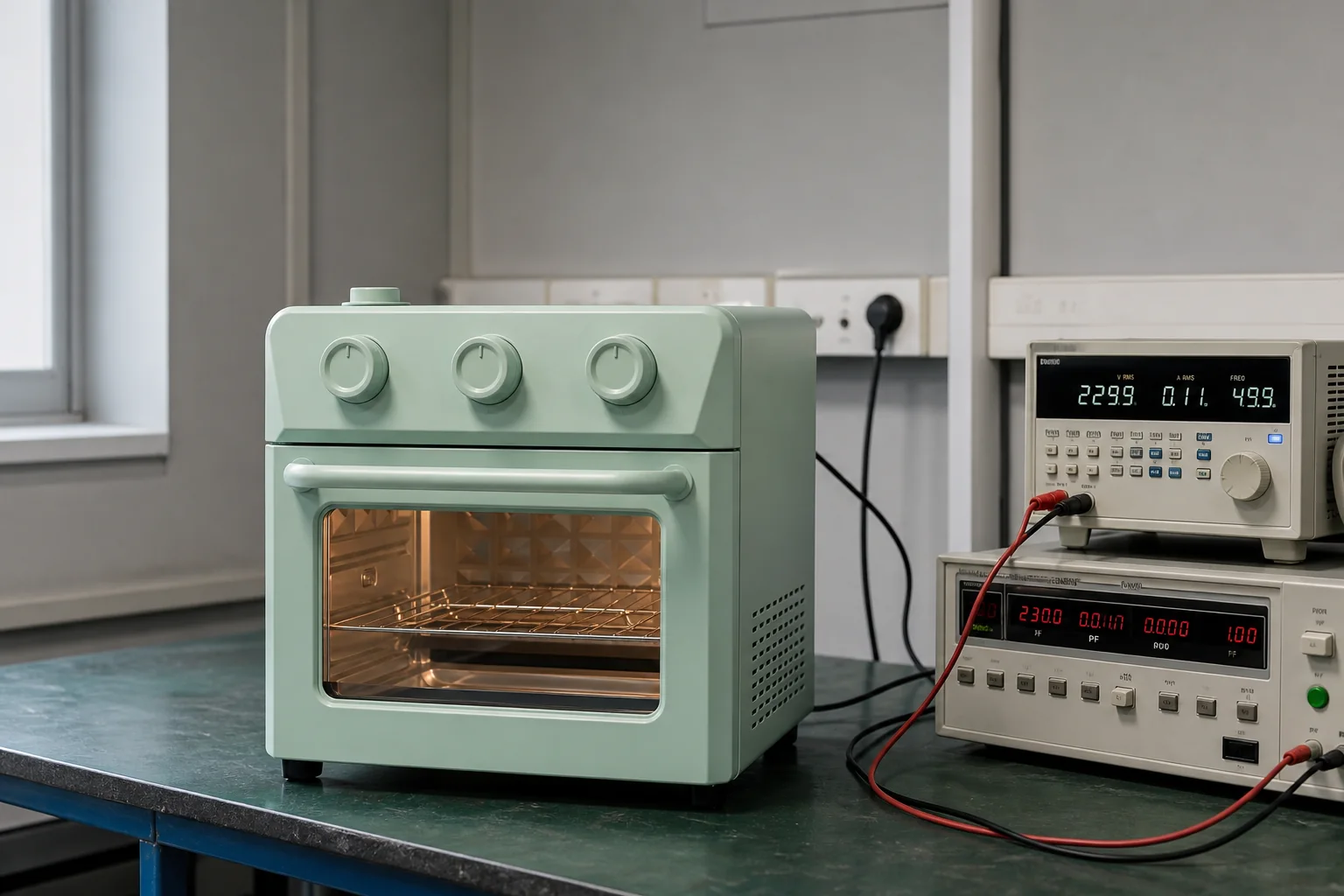
The label range is only the starting point
A buyer may see 220–240 V on two quotations and assume the ovens will behave the same everywhere in that range. They may not. A resistive heater's output changes with the applied voltage, while motors, electronic controls and protection devices have their own tolerances. A unit tested on a steady laboratory supply can feel slower on a weak circuit or under a lower local utilization voltage.
Frequency deserves its own line in the specification
For a purely resistive heater, 50 Hz versus 60 Hz is rarely the main issue. The fan motor, timer, transformer or power-supply design may still be frequency-sensitive. Ask the supplier to identify which parts are common and which change between market versions. A universal-looking control panel does not prove that the electrical build is universal.
Compare results at declared test points
Do not request one convenient preheat result. Agree the supply voltage and frequency used for cooking tests, temperature mapping, power-input checks and noise measurements. If the product is sold across a range, include low, nominal and high conditions where they matter. Record the voltage at the appliance during the test, not only the setting on the source.
A wide nameplate range is a compliance statement. It is not evidence of identical cooking time at every point in the range.
A better RFQ question
Ask for a market configuration table covering rated voltage, frequency, plug, cord, heater, motor, control board and certification file. IEC 60038 provides internationally recognized reference values for supply systems; IEC 60335-1 provides the general safety framework for household and similar appliances. Product-specific test conditions and acceptance limits still need to be agreed.
- IEC 60038 standard voltages: https://webstore.iec.ch/en/publication/153
- IEC 60335-1 appliance safety: https://webstore.iec.ch/en/publication/61880