
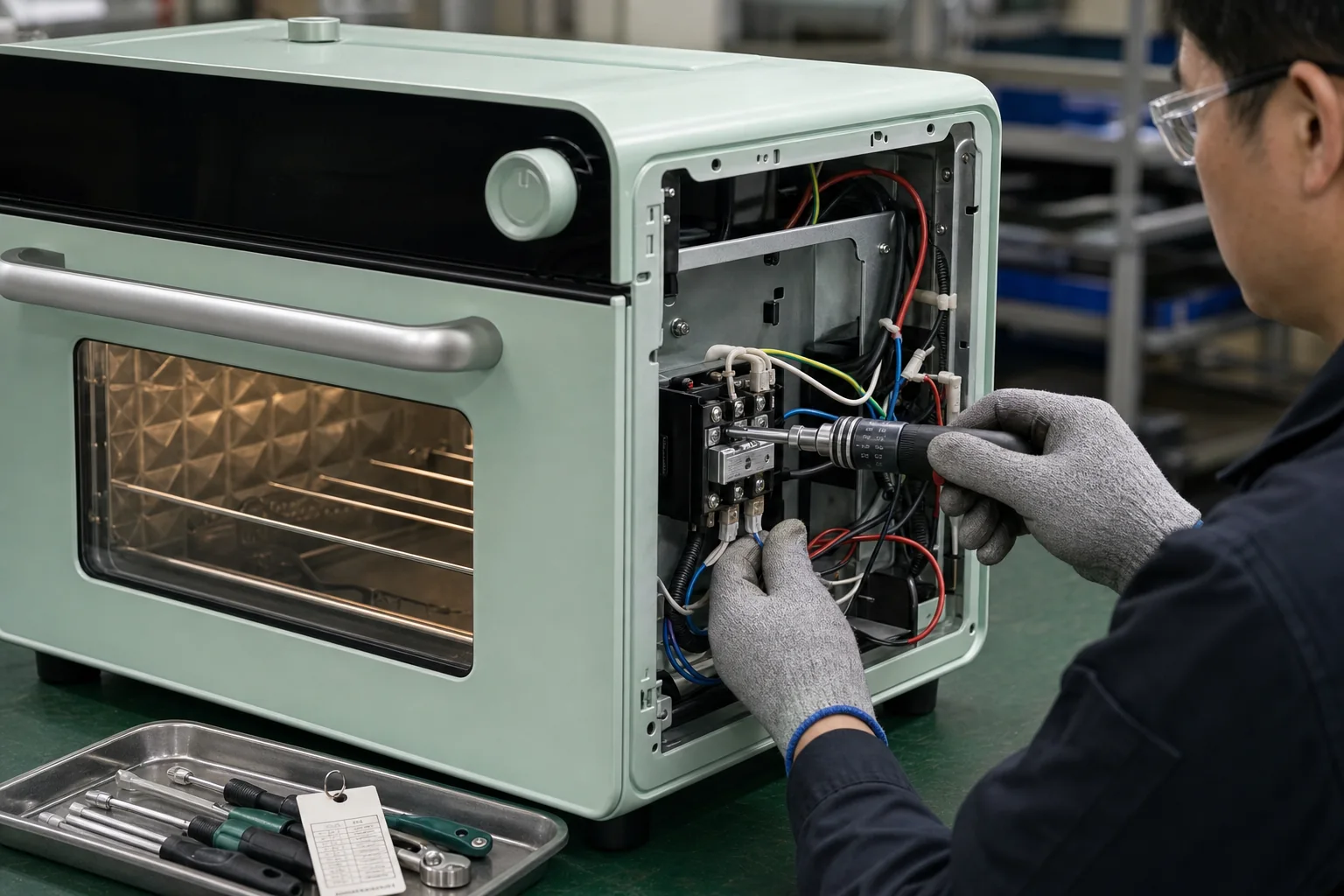
Certification approves a construction; production must reproduce it
High-current heater and mains connections are sensitive to assembly. Too little clamp force can raise contact resistance. Too much can damage threads, terminals or conductors. Stray wire strands, wrong strip length, reused fasteners and poor routing can defeat an otherwise sound design.
Torque is one control, not the whole process
A drawing value helps only when it belongs to the actual terminal and fastener combination. The work instruction should define conductor preparation, terminal orientation, torque, tool, bit, sequence and visual acceptance. Where practical, design the joint so that operators cannot assemble it in the wrong order.
Verify the tool and the result
ISO 6789-1 covers conformance and marking requirements for hand torque tools; ISO 6789-2 addresses calibration and measurement uncertainty. The factory needs a verification interval based on use, handling and risk. Do not rely on a sticker alone—review tool records, damaged bits, operator method and periodic audit results.
Look for heat after ageing
Initial torque does not tell the full story. Thermal cycling, conductor creep, vibration and material relaxation can change the joint. Run temperature-rise or thermal-imaging checks on representative production assemblies and after relevant endurance conditioning. If the terminal, wire, screw or supplier changes, review the validation.
- IEC 60999-1 conductor clamping units: https://webstore.iec.ch/en/publication/4118
- ISO 6789-1 torque tool conformance: https://www.iso.org/standard/62549.html
- ISO 6789-2 torque tool calibration: https://www.iso.org/standard/62550.html