
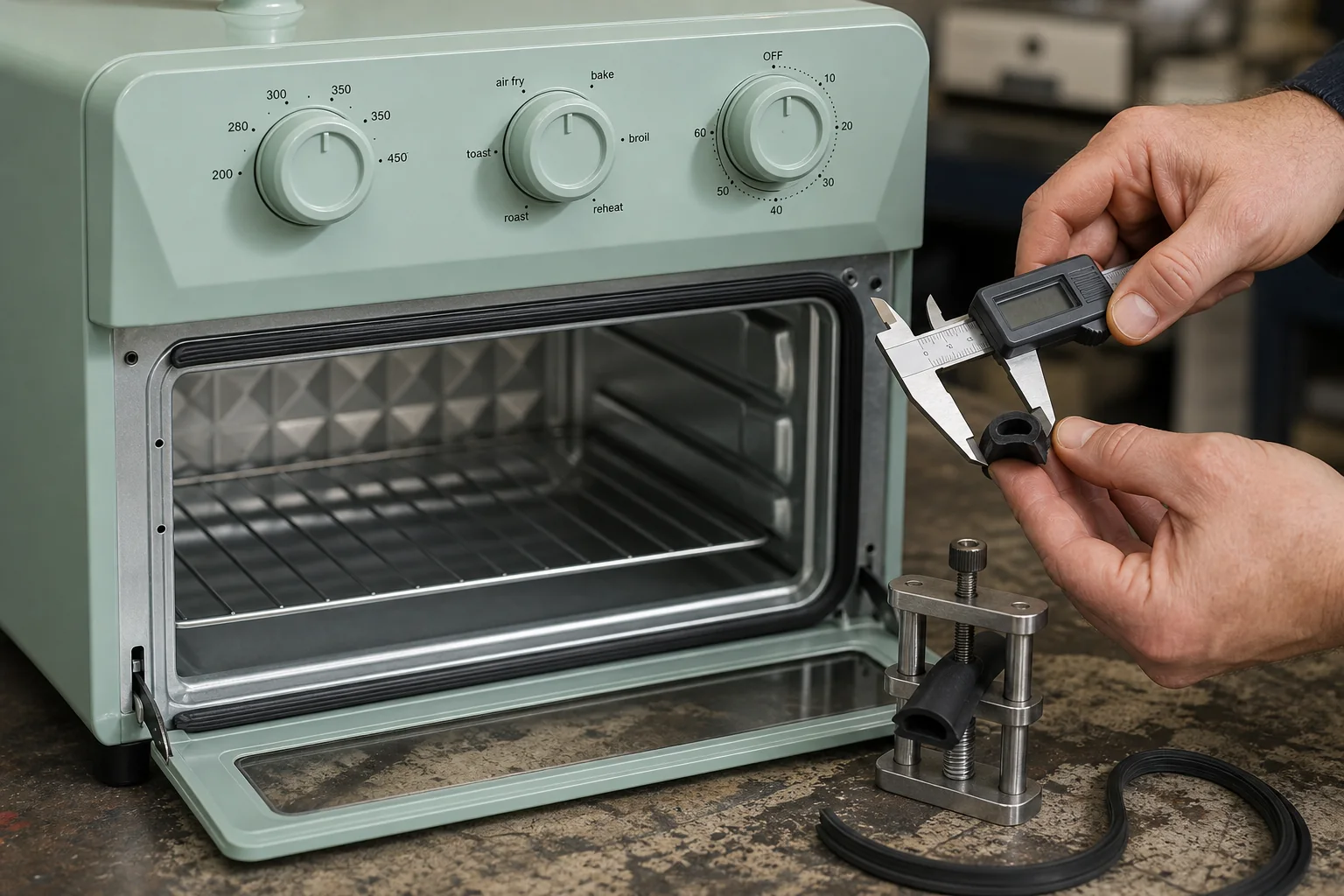
A seal can fail without cracking
Customers often look for a torn gasket, but elastomers can lose their ability to recover after spending thousands of hours compressed between the door and frame. The seal may remain visually complete while local gaps allow hot air and vapour to escape.
Compression set is the useful material clue
ASTM D395 describes methods for measuring how rubber retains elastic properties after prolonged compressive stress, including elevated-temperature testing. The result is useful for comparing compounds, but it is not a complete oven-life prediction. Real performance also depends on gasket profile, compression ratio, corner joints, retention method, door alignment and temperature distribution.
Measure the assembled door
Map the gap or contact pressure around the perimeter. Pay attention to corners, the hinge side and the latch area. After thermal cycling or endurance testing, let the product cool under a defined condition before measuring recovery. Repeat air-leakage, cavity-temperature and external-surface checks if the seal affects them.
Make replacement practical
If the gasket is a service item, define its part number, installation method and expected availability. A replacement seal with the wrong cross-section or joint length may close the door but change compression. Keep the approved material and profile tied to drawings and change control.
- ASTM D395 rubber compression set: https://store.astm.org/standards/d395
- IEC 60335-1 appliance safety context: https://webstore.iec.ch/en/publication/61880