
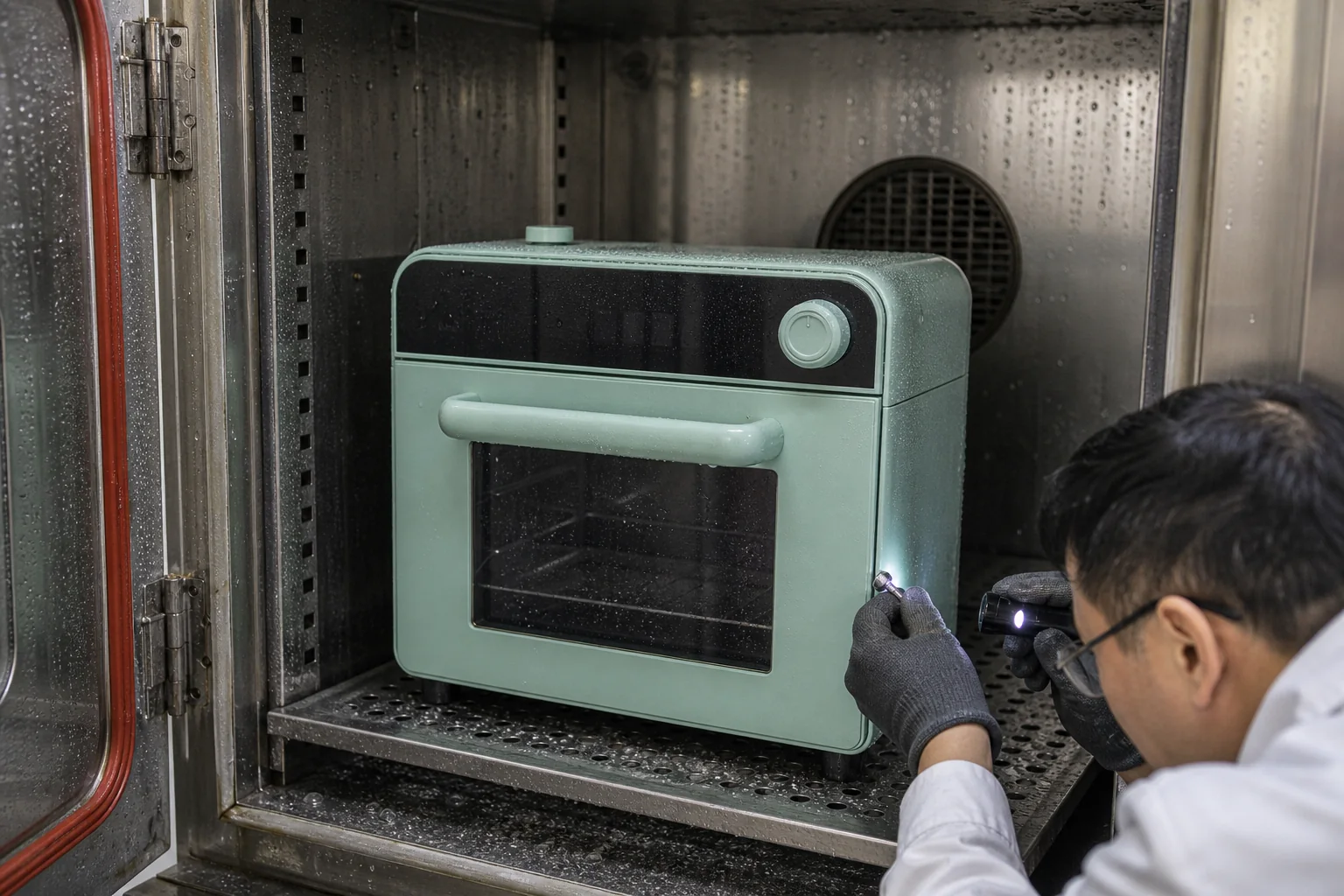
Corrosion starts in unglamorous places
A stainless-looking fascia may photograph well, yet early field failures often begin at plated screws, punched edges, welds, terminals, fan shafts or unprotected board areas. Salt deposits attract moisture. Repeated wetting and drying can create local corrosion even when the appliance is used indoors near the coast.
Choose a test that matches the question
IEC 60068-2-11 describes a salt-mist method for assessing comparative corrosion resistance and coating quality. IEC 60068-2-52 addresses cyclic salt mist for products intended to withstand a salt-laden atmosphere. Damp-heat guidance in IEC 60068-3-4 explains the role of humidity and water penetration in environmental testing. These methods are tools; none is a universal prediction of years in service.
Inspect function, not only red rust
After exposure, check protective earth continuity, insulation, connector condition, fan start-up, door hardware, coating blisters, label adhesion and control operation. Define the acceptable level of cosmetic change separately from any functional or safety failure. Photograph the same locations before and after testing.
Build a location-specific plan
Use the expected market, distance from the coast, indoor ventilation, storage conditions and service life to set the programme with a competent laboratory. Include a damp-heat sequence where condensation is credible. Materials, coatings and fastener suppliers must remain controlled after validation.
- IEC 60068-2-11 salt mist: https://webstore.iec.ch/en/publication/64484
- IEC 60068-2-52 cyclic salt mist: https://webstore.iec.ch/en/publication/61926
- IEC 60068-3-4 damp heat guidance: https://webstore.iec.ch/en/publication/70588